5 Natural deduction
Our natural-deduction proof system is a syntactic device governed by a set of rules for transforming formulas, called rules of transformation. These rules are distinguishable into:
- direct rules, which do not require subproofs, and
- indirect rules, which require subproofs.
For the sake of convenience, we can distinguish between:
- one-line direct rules,
- two-line direct rules,
- one-subproof indirect rules, and
- two-subproof indirect rules.
All of the rules are applicable to SL and FOL. The quantifier rules are applicable just to FOL.
For each rule, we will give:
- the proof-formal syntax
- a sample instance
- a summary of:
- whether and what sort of subproof is needed
- the number and kinds of line(s) cited in the justification
- the number and kinds of source(s) necessary to use the rule
- the kinds of product derivable when using the rule
- the formal syntax of the rule
5.1 Sample proof
Here is a sample proof with its parts named and described below.
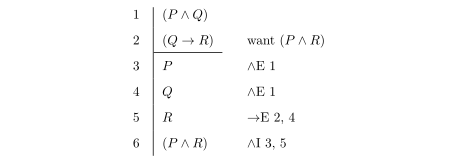
This proof is a demonstration that:
\[\{ (P \wedge Q), (Q \to R)\} \vdash (P \wedge R)\]
- The two formulas above the horizontal line are the premises
- “want \((P \wedge R)\)” is simply a note of the intended target of the proof
- “Target” in this context means: desired last line
- Lines 1–2 are the setup of the proof
- ‘\(P\)’, ‘\(Q\)’, ‘\(R\)’, and ‘\((P \wedge R)\)’ (i.e., lines 3–6) are derived formulas.
- Each derived line gets a justification. A justification includes:
- A rule
- A line number or line numbers
- E.g., the justification in line 5 (‘\(\to\)E \(2, 4\)’) is comprised of:
- the \(\to\)E rule, and
- line numbers \(2\) and \(4\)
- E.g., the justification in line 5 (‘\(\to\)E \(2, 4\)’) is comprised of: