9 Two-subproof rules
9.1 \(\leftrightarrow\)I
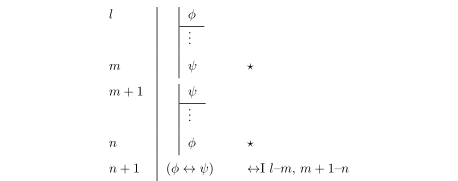
Proof-formal syntax
Sample instance
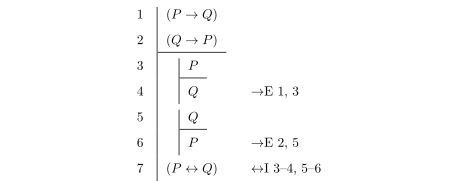
\(\leftrightarrow\)I: Summary
| Info | Description |
|---|---|
| Subproofs | \([ \phi \vdash \psi], [\psi \vdash \phi]\) |
| Justification | Two subproofs (as ranges) |
| Source | The subproofs |
| Product | A formula with [\(\leftrightarrow\) MLO] whose antecedent and consequent are the first and last lines of the first subproof respectively (=last and first lines, inversely, of the second subproof) |
| Formal syntax | \(\{[\phi \vdash \psi], [\psi \vdash \phi]\} \vdash (\phi \leftrightarrow \psi)\) |
9.2 \(\vee\)E
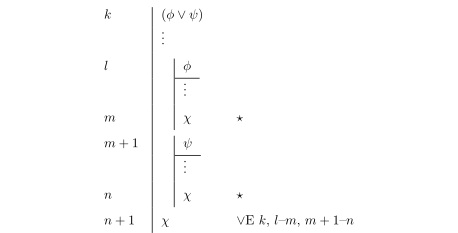
Proof-formal syntax
Sample instance
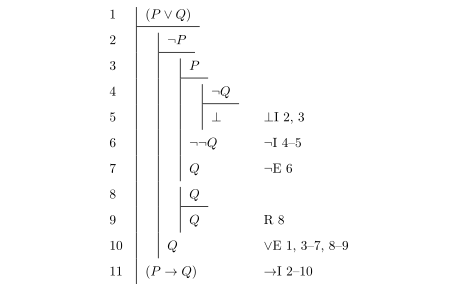
9.2.1 \(\vee\)E: Summary
| Info | Description |
|---|---|
| Subproofs | \([\phi \vdash \chi], [\psi \vdash \chi]\), given \((\phi \vee \psi)\) |
| Justification | Two subroofs (as ranges) and one line |
| Source | The subproofs and the line with [\(\vee\) MLO] |
| Product | The formula that is the last line of the two subproofs |
| Formal syntax | \(\{ (\phi \vee \psi), [\phi \vdash \chi], [\psi \vdash \chi]\} \vdash \chi\) |